Research · Fortress All-Weather · Unlevered

AlphaStrat 8.0

Own good businesses at fair prices — then size the equity book with a simple market trend gate, and keep a little ballast in Treasuries, gold, and bills. It is equity-first with a seatbelt, not a promise of smooth sailing.

Author: Brent Wood Research: July 2026 Status: Research (not Tier A locked) Spec: 0.3.0-research

20y CAGR

15.09%

2006-07-01 to 2026-06-30

Worst Decline

-36.0%

equity-like, not career-ending

Calmar

0.42

CAGR ÷ |max drawdown|

Avg Equity

~95%

still an equity book first

Start with what can hurt

AlphaStrat 8.0 can still lose a third of its mark-to-market value. The primary twenty-year path shows a maximum drawdown of about -36%. That is the cost of remaining, most of the time, a long equity investor. We do not dress it up as a low-volatility multi-asset product.

What it is not is AlphaStrat 7.0. Seven lives in another risk class: concentrated momentum with paper CAGRs that look miraculous and drawdowns that end careers. Eight was built as the opposite product idea — a foundation, not a satellite rocket. If you need the statement never to look ugly, you still do not own either of them. If you can own a quality equity process through a full market cycle, eight is built for that temperament.

The rule

Old owner's version: every quarter, decide how much of the portfolio is risk capital using a simple test of the broad market's twelve-month total return. Put most of that risk capital into a diversified book of high-quality, undervalued businesses — the same selection engine as AlphaStrat 1.0. Keep a little always in intermediate Treasuries, gold, and residual cash. Never borrow.

Equity engine — Quality + AlphaVal (AlphaStrat 1.0 rules)
Book — top 30, equal-weight, sector cap 5, hysteresis 10
Gate — SPY 12-month total return > 0 → risk-on
Equity budget — 98% risk-on · 78% risk-off
Diversifiers — IEF · GLD · residual cash (BIL_TR)
Cadence — quarterly
Leverage — none

The last line is non-negotiable. There is no TQQQ, no futures overlay, no “a little leverage to hit the number.” When deep cash floors made the fifteen-percent hurdle hard, the research did not pivot into momentum or leverage. That restraint is part of the product.

Be honest about the name. Average equity exposure on the primary path is roughly ninety-five percent. In risk-on, diversifiers are only about two percent of the book. This is equity-first with a seatbelt, not Bridgewater-style risk parity.

The Scorecard

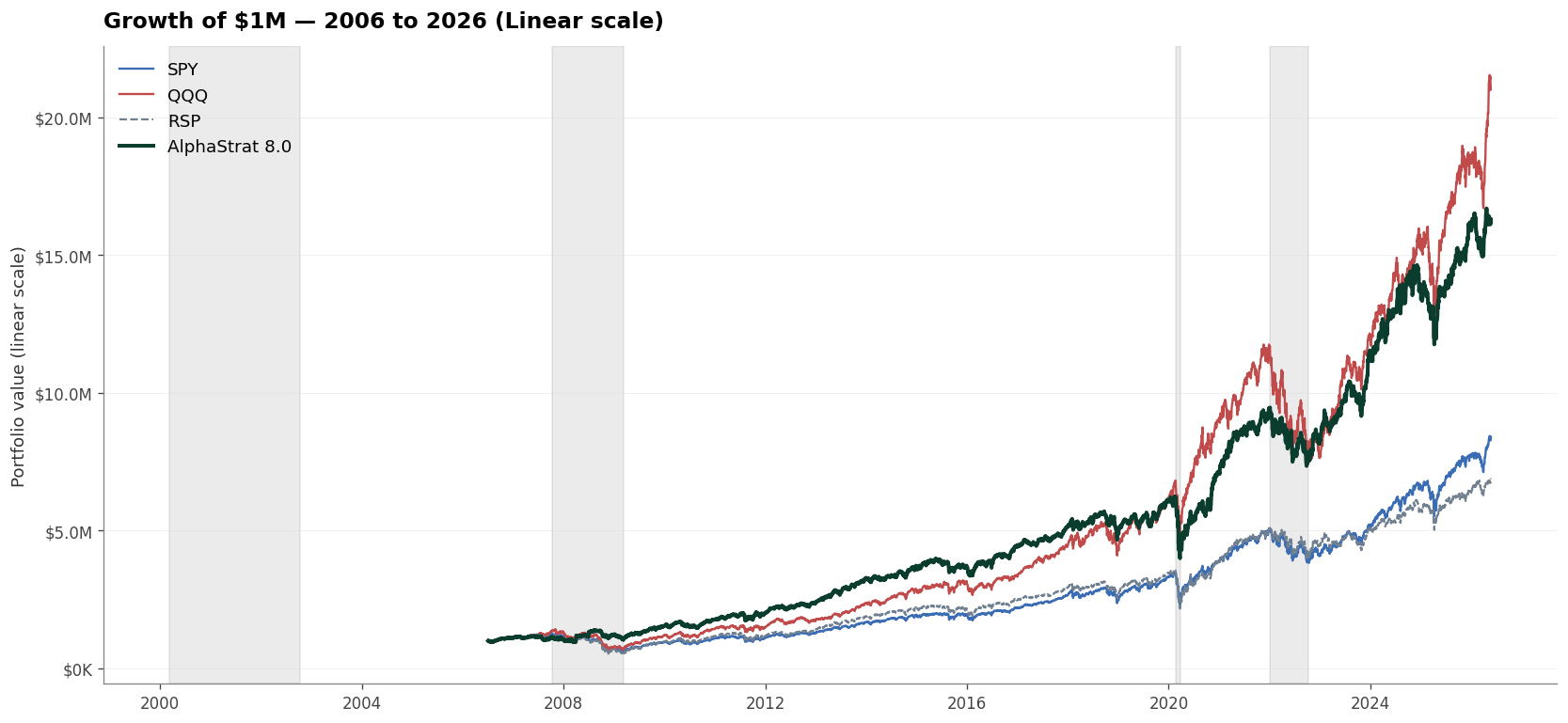
A million dollars under the primary research path (fortress sleeves on the AlphaStrat 1.0 total-return curve, July 2006 – June 2026) grew to about $16.3M — a 15.1% CAGR with a max drawdown of about −36.0% and Sharpe around 0.84. The same million in SPY would be about $8.4M; QQQ about $21.5M; RSP about $6.9M. Fifteen percent is a historical test result, not a forecast.

Chart Scale:
AlphaStrat 8.0 Growth of One Million Chart
Figure 1: Growth of $1,000,000 (2006 – 2026). AlphaStrat 8.0 plotted against SPY, QQQ, and RSP. Gray bands mark GFC, COVID, and the 2022 rate-shock bear. Equity-first with a seatbelt — not risk parity.
Metric AlphaStrat 8.0 SPY (S&P 500) QQQ (Nasdaq-100) RSP (Equal-Weight S&P)
CAGR (19.9y) 15.06% 11.30% 16.67% 10.20%
Total Return +1,528% +740% +2,046% +590%
Maximum Drawdown -36.0% -55.2% -53.4% -59.9%
Sharpe Ratio 0.84 0.65 0.81 0.57
$1M → Final Value $16.28M $8.40M $21.46M $6.90M

The research backtest

The published research path applies the fortress sleeve weights to the locked AlphaStrat 1.0 total-return equity curve — so the overlay is measured against a known compounder, not a fantasy stock path. Primary window: July 1, 2006 through June 30, 2026.

RunCAGRMax drawdownSharpeCalmar
Primary 20-year (curve on 1.0 path) 15.09% -36.0% 0.84 0.42
Longest full fortress (2005–2026) 14.59% -36.0% 0.84 0.41
Pure 1.0 same 2006–2026 era 16.21% -36.6% — reference, not 8.0 —

Crisis holes on the primary path: GFC about -26%, COVID about -36% (the path maximum), 2022 about -22%. The gate improved the financial-crisis path; it did not spare the book from an equity bear that moved faster than a twelve-month rule.

The economic cost of the overlay versus pure 1.0 in the same era is roughly one percentage point of CAGR. You buy a process and a little ballast; you do not buy a free lunch.

What this owns

In risk-on, nearly the whole book is the same kind of businesses AlphaStrat 1.0 would own: higher-quality operators with a margin of safety under the AlphaVal multi-model process, thirty names, sector limits, quarterly hygiene. A few percent sits in intermediate Treasuries and gold. Residual cash earns a bill-like return.

In risk-off — when the S&P 500's trailing twelve-month total return is no longer positive — equity falls only to seventy-eight percent. This is not a flight to cash. It is a modest de-risk. Between rebalances, equity winners may drift; diversifier ETFs are brought back to target each quarter.

Who should own it — and who should not

Own it if you want a rules-based core equity process with a written risk budget, quarterly decisions, no leverage, and the humility to accept that fifteen percent is a historical test result, not a forecast. Prefer pure AlphaStrat 1.0 if you want maximum simplicity and will not use the gate or diversifiers. Prefer neither if you need smoothness.

Do not own it because the name says fortress. Do not own it as a substitute for a true multi-asset risk-parity book. Do not own it with money you cannot leave alone for years. And do not size it so that a thirty-six percent hole forces you to abandon the rule.

Independent CIO review

Internal investment-committee style memo. Mandate: evaluate as multi-decade wealth infrastructure, not as a research artifact that cleared a CAGR hurdle. Full source: platform research note dated 2026-07-09.

Verdict up front

B / B+

Conditionally viable as a long-term core candidate — the deliberate inverse of AlphaStrat 7.0’s product mistake. A CIO would not reject it on path risk the way 7.0 is rejected. They would still demand instrument-level fidelity, a live or paper track, and honesty that “fortress all-weather” here means equity-first with a seatbelt, not risk-parity.

What a CIO actually grades

DimensionGradeComment
Edge plausibilityB+Real quality/value economics; overlay is standard; diversifiers thin in risk-on
Research / data rigorBDual mandate + no toxic pivot; curve-mode fidelity & not Tier A locked
Absolute return (backtest)B15.1% clears hurdle; thin margin; 2005 stretch misses 15%
Risk-adjusted returnB−36% MDD, Calmar 0.42, Sharpe 0.84 — core-plausible
Capacity / opsB+Liquid; quarterly; no live book yet
Regime robustnessB−Multi-regime sample; equity-dominated; gate lag
Investor survivabilityB+Holdable as core; still full equity pain in COVID

Yellow flags the IC still marks

Headline numbers are fund-of-sleeves on the locked 1.0 equity curve, not a fully audited stock-level book matched byte-for-byte to live trading. Defaults of 98%/78% equity landed after dual-mandate search — mild spec-search risk, better than 7.0’s factor pivot, still not “theory frozen first.” Not fingerprint-locked. No public AUM track. Optional QQQ risk-sleeve research was tried and correctly kept out of the default after deeper Nasdaq path risk.

IC recommendations (plain language)

1. Treat 8.0 as “1.0 + seatbelt + pocket diversifiers,” not as all-weather.
2. Do not market 15% as a forward expected return.
3. Prefer 8.0 over 7.0 wherever the mandate is multi-decade core capital.
4. Prefer pure 1.0 if you want maximum simplicity.
5. Before real size: close instrument-level fidelity (or declare curve mode permanent and size only on that honesty), paper-trade through a choppy regime, then freeze knobs.
6. Do not re-introduce leverage or momentum to “fix up” CAGR — that recreates the 7.0 failure mode.

Bottom line

AlphaStrat 8.0 is a credible attempt to build long-term wealth infrastructure on top of the platform’s best locked stock-selection engine. It passes its dual-mandate gates on the primary twenty-year window with a modest return concession versus 1.0 and radically better path risk than 7.0.

Grade: B / B+ — research-honest core candidate; approve for paper and internal capital only after instrument fidelity; never confuse it with 7.0’s satellite rocket — and never confuse it with true all-weather either.

The first rule is still sizing so the drawdown is survivable. For 8.0 that sentence is manageable. For 7.0 it was the entire review. That difference is the grade.