AI picks 2 dividend stocks to buy before end of Q2 2026
As the second quarter of 2026 unfolds, dividend stocks remain a key component for investors as broader stock markets stay volatile.
O - Realty Income Corporation
As the second quarter of 2026 unfolds, dividend stocks remain a key component for investors as broader stock markets stay volatile.
Holding a high-yield dividend portfolio in a taxable account at the 24% federal bracket means writing the IRS a $14,400 check every year on $60,000 of income that should have been yours.
Realty Income's 98.9% occupancy isn't a surprise; net leases, defensive tenants and rent recapture highlight why investors watch if it can hold.
At the 24% federal bracket, a portfolio throwing off $42,000 in dividend income hands roughly $10,080 to the IRS every year.
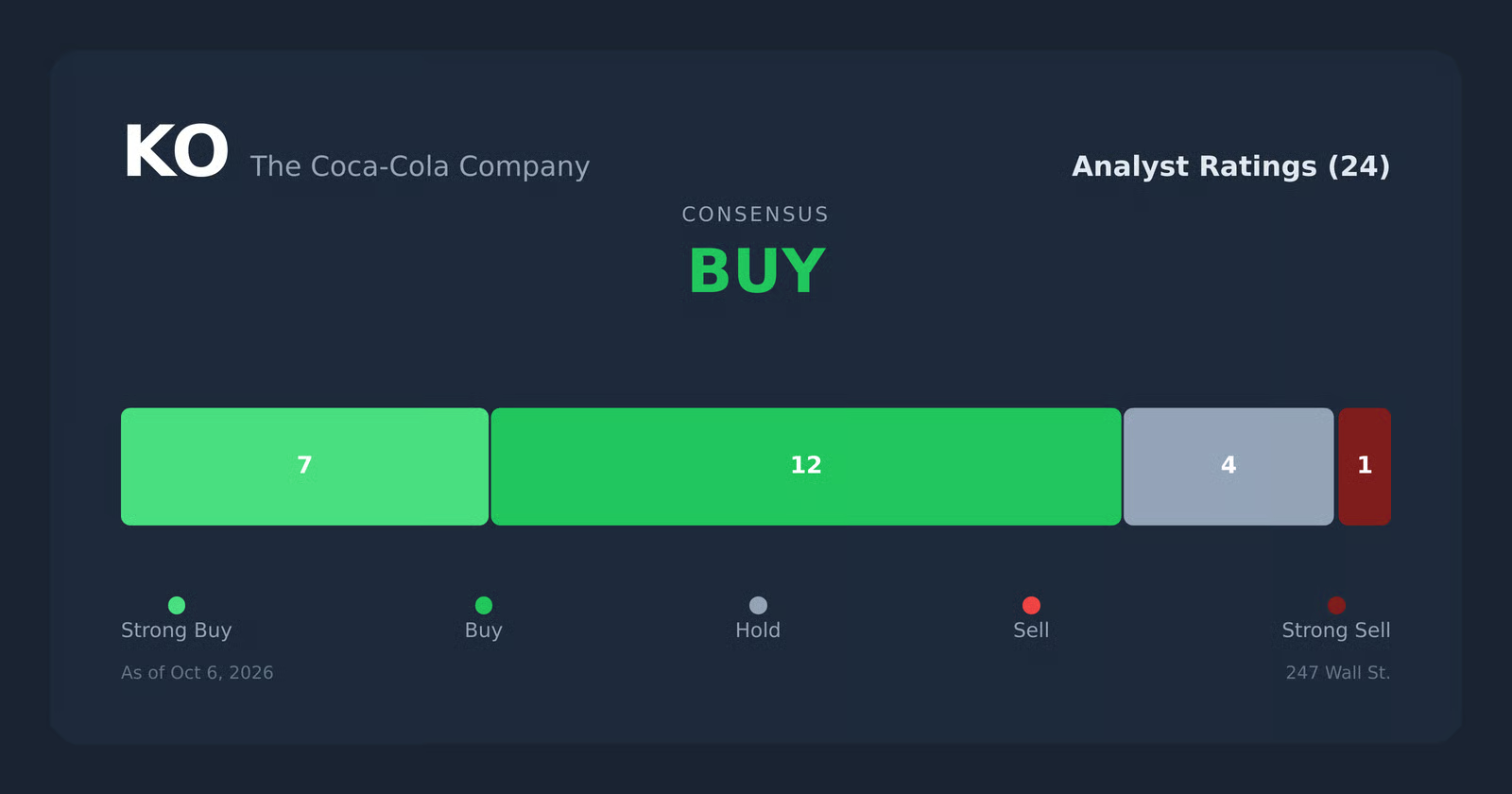
Dividend-growth blue chips like Coca-Cola double income in nine years despite lower starting yields, while high-yield BDCs and REITs with frozen payouts risk delivering less income over a decade than lower-yield growers.
The six names below sit firmly in the conservative-to-moderate tier. Five are Dividend Kings or Aristocrats.
An attractive current yield, consistent dividend growth, and a monthly payout cadence make for an ideal passive income machine for retirement. I detail 2 of my favorite monthly paying dividend growth machines that combine attractive yields with consistently strong dividend growth. I share why they are also attractive in combination, as well as the risks to keep in mind.
Altria and Realty Income are still evergreen income investments.
The U.S. median household income sits near $80,610, and a $1.1 million dividend portfolio generating a blended 7% yield would produce roughly $77,000 a year in cash flow. That level of income exceeds the median household income in most of the country, which helps explain why geography can dramatically change the retirement equation. The same... A Dividend Portfolio That Beats the Median Household Income in 47 of the 50 States on $1.1 Million Invested
A single-family rental property in Toledo purchased for $135,000 at a 9% gross cap rate would generate roughly $12,150 annually in gross rental income. After accounting for property taxes, insurance, vacancies, maintenance, and property-management costs, the net cash flow may fall closer to $5,400 per year. To replace $400,000 annually with that level of net... A $400,000 Income Portfolio That Pays Like a Toledo Rental Property Without the 3 AM Phone Calls
Realty Income, VICI Properties, and CareTrust REIT offer income reliability and stability amid macro uncertainty and rising inflation. O trades at a forward P/AFFO of 14.12x, below its five-year average, with a 5%-plus yield and strong fundamentals, making it attractive for income investors. VICI offers a 6.16% yield, 19% upside potential, and a 75% payout ratio, supported by prudent leverage and resilience despite Las Vegas headwinds.
A traditional defined-benefit pension paying $5,500 per month, or $66,000 annually, provides a useful retirement-income benchmark. That level of income sits near the upper range of what many private-sector pensions deliver, and it represents the amount a 67-year-old married couple would need to recreate if offered a lump-sum payout instead of guaranteed monthly checks for... A Monthly Dividend Portfolio That Pays Like a Pension and Beats Most Pensions on Inflation Protection
O lifts its 2026 investment target to $9.5B after $2.8B put to work in Q1, leaning on structured credit deals and private capital.
A $40,000 annual income is often enough for a 62-year-old retiree living modestly while bridging the five years until full Social Security benefits begin at 67. The challenge is generating that income entirely from dividends without selling shares or steadily drawing down principal. The core equation is simple: divide the target income by the portfolio's yield... How Much Do You Really Need Invested to Replace a $40,000 Salary at 62 and Bridge the Five Years Until Social Security at 67?
A 66-year-old couple with $850,000 spread across three accounts wants to generate $4,612 per month in portfolio income. That equals $55,344 annually, requiring a blended yield of roughly 6.5% across the entire portfolio. In the current rate environment, that target is realistic, but account placement matters as much as investment selection. With the 10-year Treasury... Here Is the $850,000 Three-Bucket Income Portfolio I Would Build to Pay a 66-Year-Old Couple $4,612 a Month
Leaving behind a $135,000 senior software engineer salary at age 52 may sound straightforward until the income-replacement math becomes real. Because most retirement accounts remain difficult or costly to access before age 59½, the burden shifts heavily toward taxable brokerage assets. That constraint changes both the structure of the portfolio and the amount of capital... How Much Do You Really Need Invested to Replace a $135,000 Tech Salary Without Touching Principal at 52?
REITs are required to distribute 90%+ of taxable income, which is why their yields run well above the broad market.
All investors should consider owning this popular REIT and the king of the beverage sector.
April 2026 delivered another major milestone for the portfolio. We posted an insane 80% year-over-year increase. In April 2026, I received $1,742.78 in dividend income compared to $968.18 in April 2025. Looking beyond just April, the full 2026 dividend income picture continues to trend dramatically ahead of 2025. The portfolio is producing significantly more cash flow through the first four months of the year.
Zacks.com users have recently been watching Realty Income Corp. (O) quite a bit. Thus, it is worth knowing the facts that could determine the stock's prospects.